Unlocking Social Emotional Learning (SEL) at Home: A Simple Guide for Parents

As parents, we want the best for our kids, not just academically, but emotionally too. We want them to be kind, confident, and resilient. We want them to understand and manage their feelings and to form healthy, positive relationships with others. But how do we go about teaching them these important skills? Enter Social Emotional Learning, or SEL.
You may have heard the term before, maybe in the context of school or education. But here’s the truth: Social Emotional Learning doesn’t have to happen in a classroom, and it doesn’t require a formal curriculum or set of lessons. It can, and should, start at home.
In this post, we’re going to break down SEL in simple, everyday terms and show you how easy it is to weave it into your family’s daily routine. By the end of this post, you’ll have practical, real-life examples you can try out today that will help nurture your child’s emotional intelligence and build a foundation for long-term success.
What is Social Emotional Learning (SEL)?
At its core, SEL is about helping children understand and manage their emotions, build healthy relationships, make responsible decisions, and develop empathy. It’s not just about “good behavior” or teaching kids to follow rules; it’s about helping them recognize their own feelings and the feelings of others, and equipping them with the tools to respond in healthy ways.
Think of SEL as the “emotional toolkit” that kids will carry with them for the rest of their lives. It’s a set of foundational skills that guide them through challenges and help them connect with others, making it easier to navigate social situations, resolve conflicts, and cope with difficult emotions.
SEL Starts at Home
Many people think that SEL is something that only happens in schools, especially with kids older than toddlers. But the truth is, SEL starts at home with simple, everyday interactions. You don’t need a special class, fancy materials, or a structured program to teach your child these important life skills. It’s all about the little moments.
Here’s how you can start integrating SEL into your day-to-day life, without adding any extra stress to your already full schedule.
1. Snack Time Chats: Talking About Feelings
Meal times, whether it’s snack time, lunch, or dinner, are great opportunities to check in with your child and encourage them to talk about their day. You don’t need to ask anything formal, just open-ended questions like:
“How did you feel today at school?”
“Did anything make you happy today?”
“Was there anything that upset you?”
Talking about emotions, even in the simplest way, helps children build emotional awareness and vocabulary. Over time, this will make it easier for them to identify and express their feelings. It also creates a safe space for them to talk about the challenges they may be facing.
If you're like me, you have a kid who isn't able to answer these questions like older kids might be able to. That's okay! One of my favorite ways to build these skills with my toddler is by modeling (which I'll talk about later). I say things like "It made me happy when we played Paw Patrol earlier," Or, Mommy has been tired today, and that has made me feel sad a bit quicker than usual." By sharing and modeling with our kids, they are learning how to express their emotions, even if they can't verbalize them yet.
With our pre-teen, we can utilize the questions above and others to drive conversations about emotions. Do it a few times, and your child will start making sure it is a regular part of meal times. We considered dinner time our daily check-in with our pre-teen, and it reached a point where he began asking us about our days and leading our check-in times. It doesn't have to be a long conversation either; a little bit of work can go a long way.
2. Playdates: Building Empathy Through Play
Playdates are more than just a chance for your child to have fun. They’re also a great way to teach social skills, problem-solving, and empathy. When kids play together, they often have to negotiate, share, and solve problems, skills that are at the heart of SEL.
Here’s how you can encourage SEL during playtime:
Model empathy: If a conflict arises, guide your child through understanding the other child’s perspective. You might say, “I see you’re upset because your friend took the toy, but how do you think they might feel if you take it back?”
Encourage problem-solving: If they’re having trouble sharing or cooperating, help them brainstorm solutions together. “What do you think would help make both of you happy? Could you take turns playing with that toy?”
Praise positive behaviors: Celebrate moments of kindness and cooperation, no matter how small. “I saw how you let your friend go first, that was really kind of you!”
Older toddlers will have an easier time with these skills than younger toddlers. When my toddler plays with his older cousins, he doesn't understand the concept of sharing or compromising yet. We teach the older toddlers patience in this, that he is still learning a skill that they already know, and then help provide them ways to problem solve with a younger kid. In teaching them, we are also teaching the younger toddler those same skills, but in a different way.
3. Bedtime Conversations: Reflecting on the Day
As your child winds down for bed, it’s a great time to reflect on the day together. Bedtime can be a quiet, intimate moment where your child feels safe to talk about their emotions.
You might ask questions like:
“What was the best part of your day?”
“Was there anything that made you feel worried or upset?”
“What did you learn today?”
This is also an excellent time to model how to calm down when upset. If your child had a tough day, guide them through a breathing exercise or teach them a technique to relax before bed.
When our pre-teen was younger, we would go through his regular bedtime routine, and when tucking him in for the night, would ask if there was anything else he wanted to talk about before bed. Sometimes, he had some BIG questions about life that couldn't be answered before bed, and we would redirect these conversations to the following day. Some days, he felt content in all things shared throughout the day or had a small thing to talk about. Othertimes, conversations about things he was feeling nervous about, upcoming changes, or other topics would come up. These were often topics that, unless talked about, were going to affect his ability to fall asleep. It became essential for us to take 10-15 minutes to discuss those concerns so that he could go to sleep feeling better. After every conversation, we would reinforce his openness about any topic he brought up by thanking him for sharing it with us. Opening up about our emotions can be challenging, and we want to encourage our kids to continue to confide in us.
4. Modeling Emotional Regulation
Children learn a lot through observation. If they see you managing your own emotions in healthy ways, they’re more likely to mirror that behavior. If you’re feeling frustrated, take a moment to explain how you’re feeling and what you’re doing to manage it.
For example, if you’re running late and feeling stressed, you might say, “I’m feeling frustrated right now because we’re running behind. I’m going to take a deep breath and try to calm down so I can think more clearly.”
If we model our emotions, we normalize and discuss emotions with our kids. So often, we as humans get the message that we have to bottle up our feelings and that strength comes in just pushing through. The truth is, strength comes in being emotionally aware, and talking about our emotions doesn't make one weak.
5. Praise Efforts, Not Just Results
SEL is about the process, not just the outcome. So, praise your child for the effort they put into managing their emotions, solving a problem, or helping a friend, even if things don’t go perfectly. For example:
“I’m proud of how you stayed calm when you got upset with your sister. That shows a lot of self-control.”
“You did a great job sharing your toys today! That was kind of you.”
I'm sure you've heard the phrase, "you catch more flies with honey". If we want our kids to display positive behaviors, phrasing them when they make positive choices is a great option. Even I, as an adult, love it when I get positive feedback for doing something good. It's human nature! Pour on the praise!
The Long-Term Benefits of SEL
The impact of SEL doesn’t end when your child leaves the dinner table or finishes their playdate. The skills they develop through social-emotional learning will serve them throughout their lives.
Kids who are socially and emotionally intelligent tend to have better academic outcomes, stronger relationships, and better mental health as they grow. They’re also more likely to handle stress and setbacks in healthier ways, making them more resilient in the face of life’s inevitable challenges.
By fostering SEL at home, you’re setting your child up for a lifetime of success, both personally and socially. And it doesn’t have to be overwhelming or time-consuming. The key is consistency and creating an environment where your child feels supported and encouraged as they learn.
Conclusion: A Little Goes a Long Way
As parents, we’re already teaching our kids valuable life lessons every day, whether we realize it or not. Social Emotional Learning is just another way to guide them in understanding their own emotions and the world around them. The best part? It doesn’t require a classroom, an expensive curriculum, or extra time in your already busy day. It starts at home, with the simple moments we share as a family.
So, whether you’re having a snack-time chat, guiding your child through a playdate conflict, or tucking them into bed, remember that the
se little moments add up to big growth. By embracing SEL in your day-to-day life, you’ll help your child develop the emotional intelligence they need to thrive: today, tomorrow, and into the future.
Share in the comments how you utilize or would like to utilize SEL at home. This blog/space is meant to help create community. By sharing, we learn. By sharing, we grow.
SEL Products
Below are 3 of my favorite SEL products, because let's be honest, I have so many learning tools I love to use. You don't have to have any products to weave in SEL lessons, but if you feel specific items would be helpful for you, that's okay too! I've found that sometimes, having specific learning items helps give me ideas over time and serves as a jumping-off point in a conversation. As a counselor, I'm constantly trying to think of new, fun ways to teach these skills, and sometimes having an easy way to integrate these skills in a game or book is a huge help. Over time, I will deep dive into specific resources and tools that I love and why, as well as how they can be utilized for SEL at home. Just click on the item's picture, and it will take you to learn more about the item.
The following portion of this post includes affiliate links. This means that if you click on a link and make a purchase of that product, I may be compensated for it. There is no pressure to buy anything, and some of these things you may be able to create on your own at home.
Do you have a favorite product or tool that you utilize? Please share it in the comments. I always love to learn about different products, and the product you share may be the thing that another parent would benefit from using.
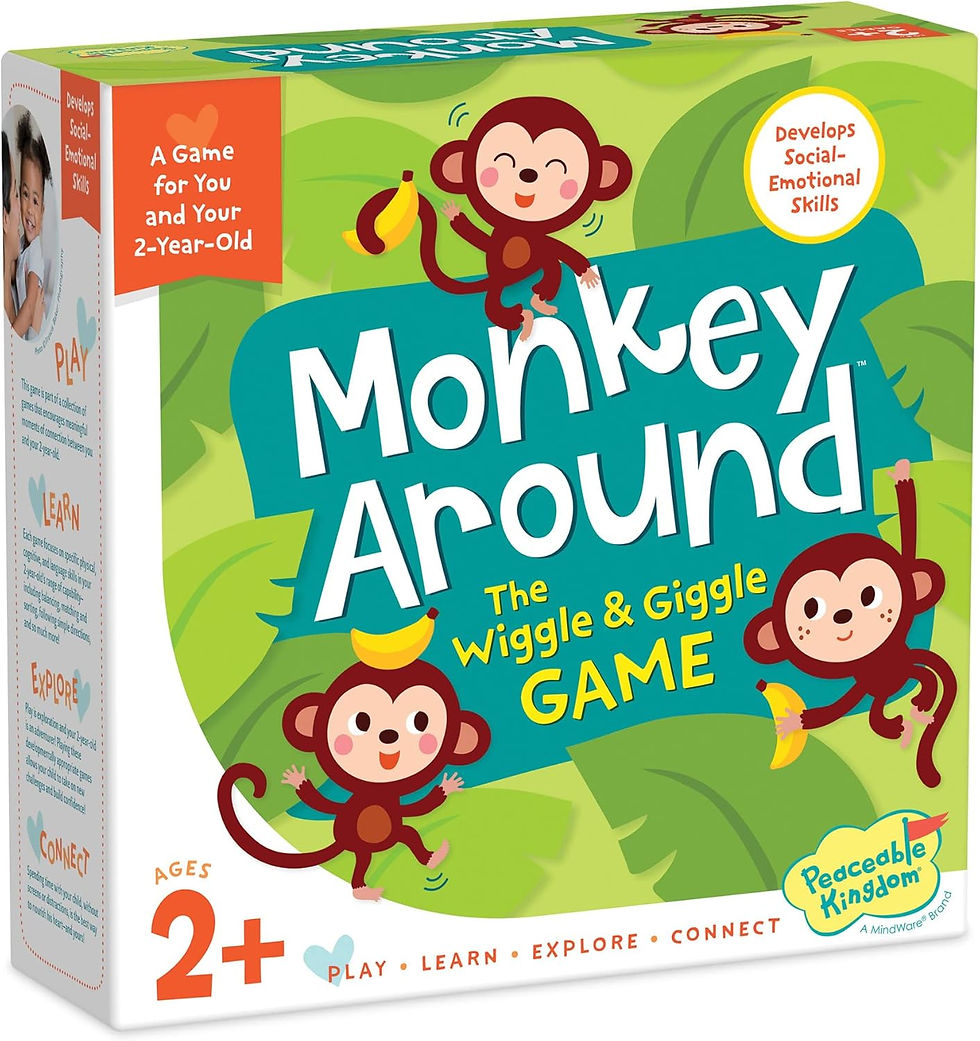
Monkey Around: The Wiggle and Giggle Game
I initially discovered this game when I bought it for my young niece five years ago. She loved it! I have used it in my work as a counselor with my youngest clients, and I recently bought another copy for my toddler to play with. He loves the silliness of the game and how silly he gets to be with his dad and me. This company makes several amazing learning games for young kids! This specific game encourages movement, interaction, helps kids build gross motor skills, work on listening and following directions, imitation, spatial awareness, hand-eye coordination, and so much more! Yes, it can even be used to help with SEL. Playing is learning. With this fun and simple game, kids are practicing taking turns, following directions, and even expressing and recognizing emotions. It also promotes positive play between you and your little one, which can help set an excellent foundation for additional SEL practice that you do in the future. This game is fantastic on so many levels and can be easily tailored to fit your little one’s developmental levels.
Mad Dragon Anger Control Card Game
This game is as easy as playing Uno. The rules are the same, except when you play a card, you answer the question or complete the prompt. Very simple, and you can easily rephrase the questions/prompts to work for different age groups if needed. This was easily the most popular “therapy game” in my office that clients would pick. Even when playing it multiple times with the same kid, answers would change based on what was going on in their lives, or they’d get different cards than they did the last time they played. This is such a great set of cards to practice modeling skills with kids and talking it out, thus building SEL skills with your kids. This game works best for elementary-aged kids and teens, but I would play this game with families as well, and parents would find benefits in talking about these topics. Games can also help promote so many additional skills and frustration-tolerance skills. I am a big believer in the power that games can play in communication and managing emotions.

Social Emotional Learning Blocks
This is a resource that I initially created when I worked in elementary schools and would do lunch bunch social skills groups. If you have Jenga blocks at home, this activity is entirely free to utilize. If you don’t have Jenga blocks and want to buy them, go for it, but you can easily weave these questions into various other games. With this resource, you will be able to utilize Jenga blocks and our question strips to engage kids in discussion about social emotional topics. To use this resource, cut out the question strips and tape or glue them to your Jenga blocks. Play Jenga as you usually would, answering a question or prompt on each block that is removed. This resource is best suited for 2nd-4th graders, but slight rewording of some of the questions can be utilized when working with Kindergarten and 1st graders. This activity focuses on starting conversations about coping skills, self-compassion, expected versus unexpected behaviors, emotions, and personal strengths. Playing it multiple times will provide different questions or prompts for your kids to answer, or if they get the same question/prompt, challenge them to give a different answer so they’re thinking more about the topic. Just click on the PDF below to access the activity.
You can use other simple games like this to weave in SEL at home. A little bit of practice with SEL goes a long way.




Comments