Parenting in the Waiting: Managing the “What Ifs” of Medical Parenting
Yesterday I cried.
My littlest twin, baby B, the one who was breech but flipped herself around when it was time to come into the world, the one we worried might be our fragile one but is scrappy, had her tongue and lip ties clipped yesterday. We had only expected an evaluation, but since the dentist had time, we went ahead with the procedure.
And I had to do it alone.
That’s the part that still weighs on me. My husband is out of town for work, and since we hadn’t planned on having the procedure done yesterday, I didn’t have an adult helper. I had to choose: be in the room with her as she underwent the procedure, or sit in the hallway with her siblings. There was no “right” answer, only the one that felt most possible in the moment. I could sit with my toddler and my older twin, but I chose to sit with her, to let her hear my voice even as she cried. A kind hygienist sat with my other two children and even held my older twin when she started crying. From the procedure room, I could hear my older twin's cry mingling with my younger twin’s cries, and it nearly shattered me.
The guilt was thick. Guilt for not being in two places at once. Guilt for putting her through short-term pain, even though I knew it was for long-term good. Guilt for not being able to protect my babies from all the discomfort.
And yet, I also knew we made the right decision. Having the ties clipped now would spare her from continued feeding challenges, potential speech difficulties, and potentially harder interventions down the road. My husband, who grew up with a cleft lip and palate and endured 15+ surgeries, has carried enough pain in his story. We want something different for all of our kids, but we can’t stop everything. What we can do is take care of procedures like this early, when there is less anxiety involved and ultimately, less trauma.
Still, once the procedure was done and the kids were all strapped into the car, asleep in their seats, I parked in our driveway and sobbed. Because the truth is, these tears weren’t just about today’s procedure; they were about everything else looming in front of us.
That evening, my guilt crept back in. I had to work despite knowing my baby girl was in pain from her procedure. She just wanted to be held, and the guilt of not being able to comfort her entirely ate at me. Even in the hands of people I trusted, I wanted to be the one to soothe her. When it came time for her next bottle, and she refused it from anyone else, I scooped her into my lap during my session. Just being with me calmed her, and she sat quietly in my arms while I worked. This wasn’t the first time one of my babies had been with me during work. When the girls were first born and we were adjusting to my return to work, I would take one of the girls in with me so my husband could focus on our other daughter and our son. I know how challenging all three could be to adjust to, so taking one of them helped him feel less overwhelmed, too. My now two-year-old spent most of his first year and a half by my side at work, earning the nickname “emotional support baby.” My clients adored him, and they were always so understanding and supportive of his presence. So having my baby girl need to be with me during a session didn’t faze me; it just reminded me that sometimes the best support is simply being there, fully present.
Living in the Land of “What Ifs”
Parenting a child with medical needs, even when the diagnosis isn’t clear, means living with the relentless “what ifs.” Even saying she has medical needs without a diagnosis makes me feel like an imposter, as though her symptoms aren't as real until a diagnosis is in place. But, they are. She has days when she's more uncomfortable than others. Days when she is retaining more fluid, when her circulation is worse, when she needs more stretching because her little body is stiffer. Then the stupid "what ifs" creep in.
What if it’s something bigger than we think?
What if I miss a symptom?
What if I’m not enough for her?
What if I fall apart before she gets the care she needs?
The “what ifs” feel like constant background noise, humming in my mind even in the sweetest moments. I can be holding my daughter, soaking in her giggles, and still feel that buzz of anxiety under the surface.
Now, in this new season of waiting for answers, I find myself facing the “what ifs” again. Only this time, I’m learning how to manage them better.
How I’m Learning to Manage the “What Ifs”
If you’re walking this road too, here are some ways I’ve found to quiet the noise of uncertainty:
Anchor to the Present
When my thoughts start spiraling into the future, I gently bring myself back to what I know is true right now. "Today, she is smiling. Today, she is safe. Today, I can hold her in my arms." The future will come, but I don’t need to live all of it today.
Create Routines of Calm
Medical parenting often feels chaotic, filled with appointments, specialists, and new information. Establishing small rituals, morning snuggles, bedtime songs, and even a quiet moment with coffee, gives our family a sense of predictability and peace.
Give Yourself Permission to Feel
I’ve learned to let the tears come. The sobs in the driveway after an appointment aren’t weakness; they’re release. They allow me to step back into the house with a steadier heart for my kids. Strength and vulnerability can coexist.
Find Safe Spaces to Talk
Whether it’s a trusted friend, a counselor, or another parent walking a similar path, having a place to voice the “what ifs” out loud helps; keeping them bottled up only makes them louder.
Shift the Language: From “What If” to “Even If”
This has been one of the most powerful tools for me. Instead of saying, “What if the neurologist gives us hard news?” I try to shift to, “Even if the road is hard, we’ll face it together.” That one change reframes fear into resilience.
The Pull Between Roles
This season has forced me to look closely at how I’m showing up for my kids and myself. For months, I tried to juggle work alongside motherhood, slipping into “professional mode” for a few hours in the evenings before diving straight back into parenting. But the truth is, my heart and attention were always split.
I’d be working while straining my ears for a cry in the next room. My older twin, Baby A, has a cry that demands attention, loud, clear, insistent. But Baby B, the one we now wait and watch over, is softer. Her cries are quieter, easy to miss if you’re distracted. And because of her medical history, her fluid retention, her stiffness, her fussiness often makes me wonder, "Is this something bigger? Is she in pain? Or does she want to be held?"
The “what ifs” didn’t just show up in the medical world; they seeped into the everyday moments, too.
I recently decided to step back from working. It wasn’t an easy decision, but it was the right one. This season with my babies is fleeting, and I can’t get it back. I want to be fully available, to hold her when she fusses, to show up with presence instead of distraction. I know not every parent has this option, and I don’t take it for granted.
The Challenges and Joys of Raising Twins
And then there’s the challenge of raising twins, on top of also having a toddler. Some days it feels like no matter what I do, I’m not doing enough for anyone. When I’m holding one baby, I feel guilty that I’m not holding the other. When I’m tending to a medical need, I feel guilty that my toddler just wants me to play. My energy is divided into thirds, and my emotions are stretched thin. By the end of the day, I’m worn down, sometimes even questioning if I showed up “well enough” for any of them. And yet, I keep going. I keep showing up, because that’s what my tiny humans need, not perfection, but presence. They don’t need me to do it all; they just need me to keep choosing them, over and over again.
But alongside the challenges, twins bring an unexpected kind of magic. Watching their bond unfold has been one of the sweetest gifts of motherhood. The way they look at each other, giggle at sounds no one else finds funny, or settle just by being near one another, it’s like they already speak a secret language only they understand. And when our toddler joins in, the three of them create this beautiful chaos that reminds me why I keep pushing through the exhaustion. The love between siblings is louder than the guilt, brighter than the fatigue, and stronger than the “what ifs.” Their laughter pulls me back into the present, reminding me that even in the hard, there is joy worth holding onto.
Yes, I’m stretched thin. Yes, I often feel guilty. But these three remind me daily that love multiplies, it doesn’t divide. The giggles, the cuddles, the chaos, it’s all proof that even in the messiest, most overwhelming moments, there’s beauty that makes the hard parts worth it.
Rediscovering Connection
I’ll admit something vulnerable: I didn’t always feel as bonded to Baby B.
In her earliest days, all of our attention went to her sister, who faced life-threatening breathing issues that required oxygen, NICU and PICU stays, and constant vigilance. I spiraled into postpartum anxiety. In the chaos, Baby B slipped into the role of the “easy baby”, quiet, undemanding, along for the ride. My postpartum anxiety and depression whispered lies: "You’re not connected to her. She doesn’t need you the way her sister does."
But then, one day, she smiled at me. It wasn’t a small, fleeting grin; it was her first genuine, intentional smile. And it was for me. It was like she was saying, “Mom, I see you. I know you. I’m connected to you.”
That smile cracked the lies, my anxiety whispered, wide open. She was connected to me all along.
Fast forward to now, and I cling to those reminders of connection, her giggles, her snuggles, her wide-eyed gaze. They remind me that even in uncertainty, she is fully here, fully mine, fully known.
Postpartum Depression and Anxiety: Recognizing the Signs
In the moments of my postpartum anxiety and depression, I didn’t always recognize it as such. And that might surprise you, I’m literally trained as a counselor, specifically in supporting women through infertility, perinatal, antenatal, and postpartum mental health. Yet even with that training, I didn’t fully recognize the signs within myself.
Postpartum depression (PPD) and postpartum anxiety (PPA) are far more common than many realize. Studies show that roughly 1 in 7 women experience postpartum depression, and rates of postpartum anxiety are just as high. Symptoms can include:
Persistent feelings of sadness, emptiness, or guilt
Irritability or anger that feels unmanageable
Anxiety, racing thoughts, or constant “what if” scenarios
Feeling disconnected from your baby or other children
Difficulty sleeping even when given the chance
Trouble concentrating or making decisions
Loss of interest or pleasure in things that once felt joyful
These feelings go beyond the "baby blues" which are the first two weeks after delivery.
Even when symptoms are subtle, they can have a significant impact on your ability to rest, bond, and care for yourself. And as I learned personally, being educated on mental health doesn’t make you immune to it; in fact, sometimes it makes it easier to dismiss your own feelings, assuming you “should know better.”
The most important thing to know is that you don’t have to navigate this alone. Reaching out for support is a sign of strength, not weakness. One excellent resource is Postpartum Support International (PSI), which offers free support, peer groups, and professional help to parents experiencing PPD or PPA. You can find them at https://www.postpartum.net.
It’s also important to talk to your OBGYN or your child’s pediatrician about your symptoms. Many doctors perform routine postpartum depression screenings, but even if you’ve already been screened, bringing up your feelings can make a huge difference. Early recognition and support can help you feel less alone, better able to care for yourself, and more present for your children.
Remember: asking for help isn’t a failure, it’s a step toward healing, connection, and resilience.
The Strength of My Girl
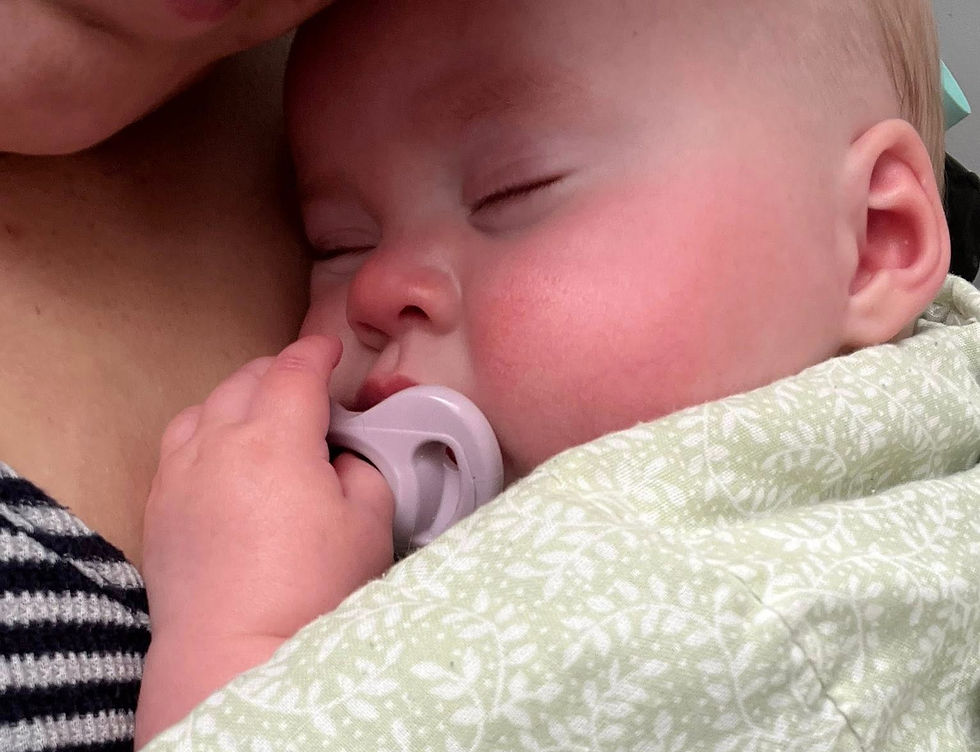
Every day, I see her strength. She has endured quiet discomforts that only she can feel. And through it all, she smiles. She giggles. She delights in the smallest joys.
I thought I knew what strength looked like, but she’s teaching me a new definition.
So for now, I’ll hold her close. I’ll let her joy be the medicine for my anxious heart. And when the “what ifs” start to rise, I’ll remind myself: "She is strong. I am her mom. And together, we will face whatever comes."
Because sometimes the bravest thing you can do is keep showing up, even when the answers aren’t clear.
A Letter to the Parent Who’s Waiting
If you are reading this while sitting in a waiting room, refreshing your email for test results, or staring at the ceiling at 2 AM, wondering about the future, this is for you.
You’re not alone.
The “what ifs” are heavy, and they can feel like they’ll swallow you whole. But you don’t have to figure out the entire road today. You only have to take the next step. Hold your child. Wipe your tears. Ask for help. Take a deep breath. That’s enough for right now.
Even if the answers ahead are hard, you and your child are stronger than you think. Love is stronger than fear. And you don’t have to have it all figured out, you just have to keep showing up.
One day at a time. One appointment at a time. One heartbeat at a time.
You’ve got this, even when it feels like you don’t.


Comments